Quick Links
Transit Impacts, Benefits, and Facts
Comprehensive Impact Reports**
2025 Virginia Transit + Passenger Rail Impact Overview (FY2025)
2025 Virginia Transit + Passenger Rail Impact Overview (FY2024)
2024 Virginia Transit + Passenger Rail Impact Overview (FY 2023)
2023 Virginia Transit + Rail Impact Overview (FY 2022)
Statewide Impact Overviews**
2024
2023
2021
2020
2019
2023 Transit Impact Profiles**
Alexandria Transit Company (DASH)
Arlington Transit (ART)
Bay Transit
Blacksburg Transit (BT)
BRITE Transit
Charlottesville Transit Service (CAT)
City of Fairfax, CUE Bus System
Danville Transit System
Fairfax County Connector
Four County Transit
Fredericksburg Regional Transit (FXBGo!)
Greater Lynchburg Transit Company (GLTC)
Greater Roanoke Transit Company, Valley Metro
GRTC Transit System (Richmond)
Hampton Roads Transit (HRT)
Harrisonburg Public Transit
JAUNT, Inc
Loudoun County Transit
OmniRide
Petersburg Area Transit (PAT)
Radford Transit (RT)
STAR Transit
Suffolk Transit
Virginia Railway Express (VRE)
Virginia Regional Transit (VRT)
Washington Metro Area Transit Authority (WMATA)
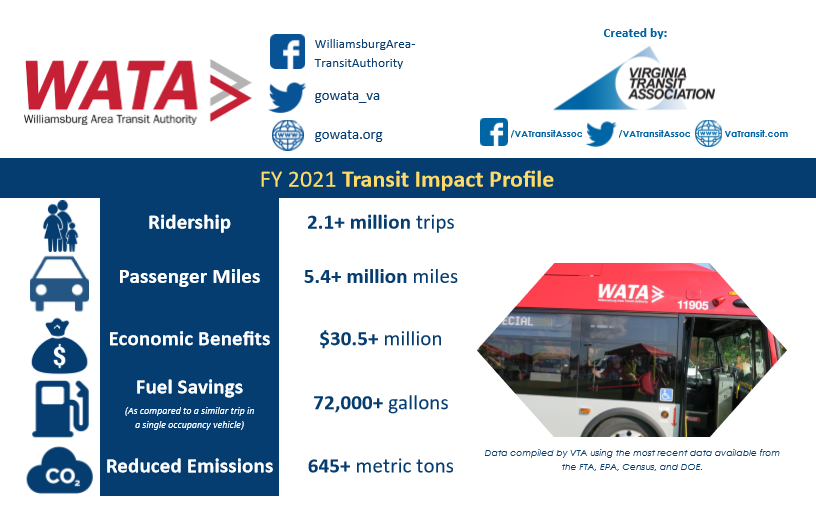
Williamsburg Area Transport (WATA)
Winchester Transit System
**Notes: The data in these impact overviews is compiled by the Virginia Transit Association (VTA) from multiple sources. We go to great lengths to use the most recent and reliable data available. The ridership numbers are provided by the Federal Transit Administration’s (FTA) annual National Transit Database (NTD) transit system profiles. The population data is collected from the US Census. The fuel savings and emission data are gathered from the Environmental Protection Agency (EPA) and the US Department of Energy (DOE) annual reports and compare energy usage for a transit trip by mode compared to a similar trip in a single occupancy vehicle (SOV). The economic benefits data is compiled from various studies and reports including those by the American Public Transportation Association (APTA), the Virginia Department of Rail and Public Transportation (DRPT), New Mexico State University, and Mississippi Research Center, among other sources.